
What it does
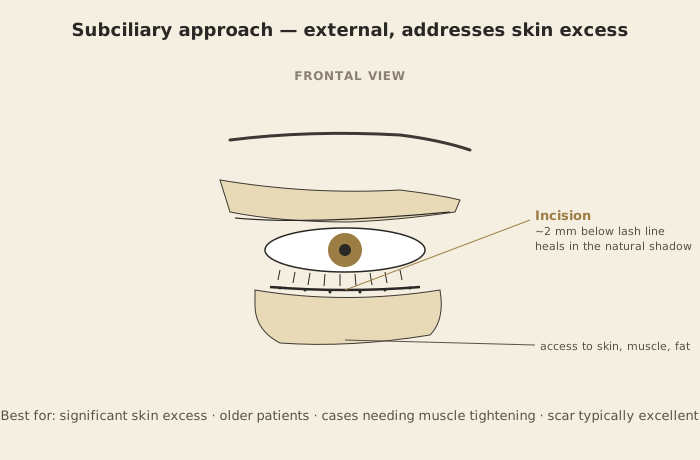
The subciliary approach gives access to all the lower lid structures at once: skin, muscle (orbicularis), septum, and fat. It is the technique of choice when:
- Significant lower lid skin laxity is present
- Festoons or malar mounds need addressing
- Muscle tightening or canthal support is needed
- The patient is older (typically 55+) with both skin and fat concerns
Why subciliary is technically more demanding
Subciliary surgery has a higher complication profile than transconjunctival — specifically the risk of lower lid retraction (the lower lid being pulled downward, exposing white sclera below the iris) and ectropion (the lid edge turning outward).
These complications are technique-dependent, not approach-dependent — they occur when:
- Too much skin is removed
- The orbicularis muscle is over-resected, weakening the lid support
- Canthal support is not added when needed
- The lid has a negative vector and no canthopexy is performed
For these reasons, modern subciliary surgery typically combines conservative skin removal with canthopexy — tightening the outer corner — to support the lid in its new position.
Step-by-step
- Marking while the patient is awake — the incision line is marked 2 mm below the lash line.
- Skin-muscle flap. A flap of skin (and a small strip of pretarsal muscle) is elevated downward, exposing the orbital septum.
- Fat compartments addressed — opened, with conservative removal or (preferred) repositioning over the orbital rim to fill the tear trough.
- Canthopexy performed if the lid laxity exam suggests support is needed (the "snap-back test" is positive).
- Skin trimmed conservatively — the patient asked to open the eyes and look up; only the skin that bunches under tension is removed.
- Closure with fine sutures along the lash line.
Frequently asked questions
How visible is the subciliary scar?
The incision sits in the natural shadow below the lash line and typically heals very well. At 3 months it's usually invisible without close inspection; at 6 months invisible to anyone not specifically looking for it. Pinkness in the first 8 weeks is normal; it can be camouflaged with concealer from day 14.
What is lower lid retraction and how do you prevent it?
Retraction is the lower lid being pulled downward after surgery, exposing white sclera between the iris and the lower lid edge. It's the most-feared cosmetic complication of subciliary surgery. Prevention is technique-based: conservative skin removal, preserving muscle support, and adding canthopexy in cases with lid laxity or negative vector. Patients with these risk factors are usually steered toward transconjunctival + skin pinch instead.
Can I have subciliary if I have a negative vector?
Yes, but the surgical plan must include canthopexy or canthoplasty for lower lid support. Without that support, the risk of retraction is too high. In some negative-vector patients, transconjunctival with skin pinch is a safer alternative.
Is recovery worse than transconjunctival?
On average, slightly. The external incision creates more visible bruising and a higher chemosis (lid swelling) rate. The functional recovery is similar but the cosmetic recovery is 3–5 days longer.
Not sure if you're a candidate?
Blepharoplasty is most successful when patient anatomy, age, and goals align with what surgery can realistically deliver. Send three facial photos (front, profile, eyes-closed) and Doç. Dr. Erdal will give you an honest, no-pressure suitability assessment before you commit to anything.
Ready to discuss your case?
Doç. Dr. Erdal personally reviews every enquiry. Honest assessment of whether blepharoplasty is right for you, with no pressure to book.