
What 'negative vector' actually means
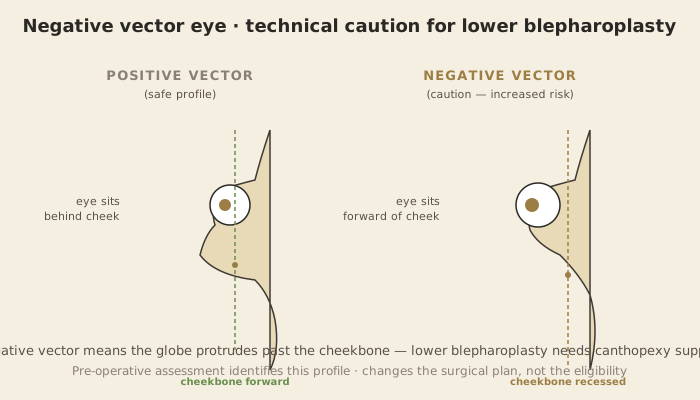
In profile view, draw a vertical line down from the most anterior point of your eye globe (essentially the front of your iris). Look at where that line falls relative to your cheekbone (specifically, the anterior projection of your malar eminence).
- Positive vector: cheekbone projects forward of the globe. Standard anatomy. Standard surgical risk profile.
- Neutral vector: cheekbone and globe at same projection. Mild caution.
- Negative vector: globe projects forward of the cheekbone. The eye 'protrudes' past the cheek support.
Why it matters for lower bleph
In a positive-vector eye, the cheek provides natural support for the lower lid — the lid 'rests' against the bony cheek. In a negative-vector eye, this support is absent. Any surgical force that pulls the lower lid downward (orbicularis tightening, skin removal, scar contracture) is more likely to actually pull the lid down — producing scleral show.
The lid in a negative-vector patient is operating without a safety net.
How the surgical plan changes
For a negative-vector patient considering lower bleph, the plan should include:
- Preferential transconjunctival approach — internal-only access avoids the dissection that risks retraction
- If subciliary is required: mandatory canthopexy or canthoplasty for lateral support
- Conservative skin excision — even less than usual
- Lower-lid support assessment — full snap-back testing
- Consideration of orbital rim implant in extreme cases — projecting the bony framework forward to improve support
Can negative-vector patients still have lower bleph safely?
Yes — the finding changes the plan, not the eligibility. What it does mean is:
- Surgeons inexperienced in negative-vector cases should refer or decline
- Standard 'package' surgery without anatomical assessment is dangerous
- The patient should be specifically informed of this finding and how the plan accommodates it
A surgeon who doesn't mention vector during your lower-bleph consultation either hasn't examined for it, or is glossing over it. Either is a warning sign.
Frequently asked questions
How do I know if I have negative vector?
It's an examination finding rather than something you can self-diagnose precisely. A side profile photo can suggest it; definitive assessment is by the surgeon in person.
Ready to discuss your case?
Doç. Dr. Erdal personally reviews every enquiry. Honest assessment of whether blepharoplasty is right for you, with no pressure to book.