
What blepharoplasty actually does
Blepharoplasty is the surgical reshaping of the eyelid — upper, lower, or both. The goal is to address one or more of:
- Skin excess on the upper or lower lid that creates a "tired" or "heavy" appearance
- Herniated fat in the lower lid producing the visible bag
- Tear-trough deformity — the hollow groove from the inner corner across the lower lid
- Loss of lid platform — when hooded skin completely covers the upper crease
- Functional vision impairment when hooded upper skin obstructs peripheral vision
What it does not change: the bony orbit, the eye position, the eyebrow height, pigmentation, fine wrinkles outside the lid area (crow's feet), or the long-term tendency of the face to lose volume with age.
Upper vs lower — which do you need?
You probably need upper blepharoplasty if:
- Excess skin hangs over your upper lash line
- You no longer have a visible eyelid crease (or it only shows when you raise your brow)
- Putting on eyeshadow has become difficult — the crease can't be seen
- You catch yourself raising your brow to "lift" the skin out of your line of sight
- Friends/family describe you as looking "tired" despite adequate rest
You probably need lower blepharoplasty if:
- You have persistent under-eye "bags" or puffiness, especially in the morning
- The lower lid shows a clear horizontal "step" between bag and cheek
- Concealer doesn't camouflage the lower lid contour
- Photographs show shadow under your eyes even in flat lighting
- The tear-trough hollow from the inner corner is visible
About 40% of patients we see benefit from both upper and lower together (quad blepharoplasty) — and the combined procedure is more efficient than two separate operations.
Technique choices for the lower lid
The lower lid has two main approaches, and the choice meaningfully affects what can be achieved and what scars are involved.
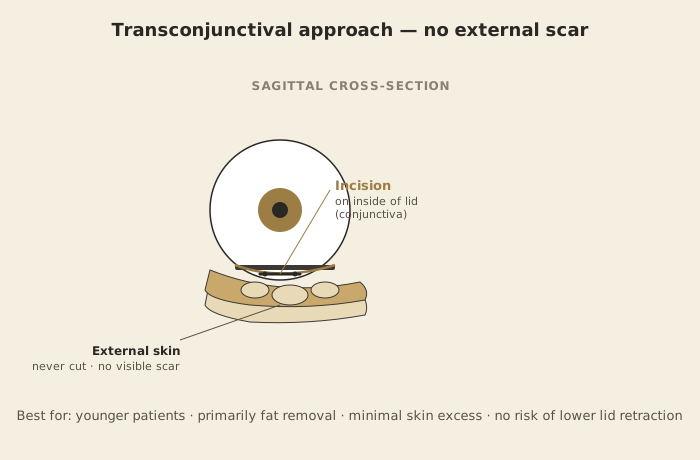
Transconjunctival approach
The incision is made on the inside of the lower lid (the conjunctival surface). Through it, the surgeon can address the three lower fat compartments — remove or reposition them — but cannot directly remove external skin. No external scar. Best for younger patients (under ~45) where the lower lid skin is still elastic, and for patients whose primary concern is fat (bags) rather than skin.
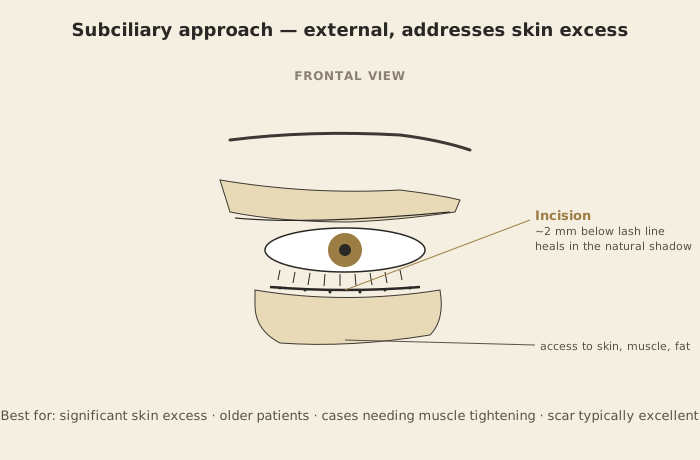
Subciliary approach
The incision is made externally, 2 mm below the lash line, in the natural shadow. Through it, the surgeon can address skin, muscle, and fat together. The scar typically heals very well but is technically external. Best for older patients with significant skin excess, festoons, or cases needing concurrent muscle tightening or canthopexy.
Recovery — the honest timeline
Blepharoplasty has a deceptive recovery: the procedure itself is short and the technical recovery is fast, but the cosmetic appearance during healing is the slow part. You will look unattractive for 10–14 days, then increasingly normal, then natural by 6 weeks.
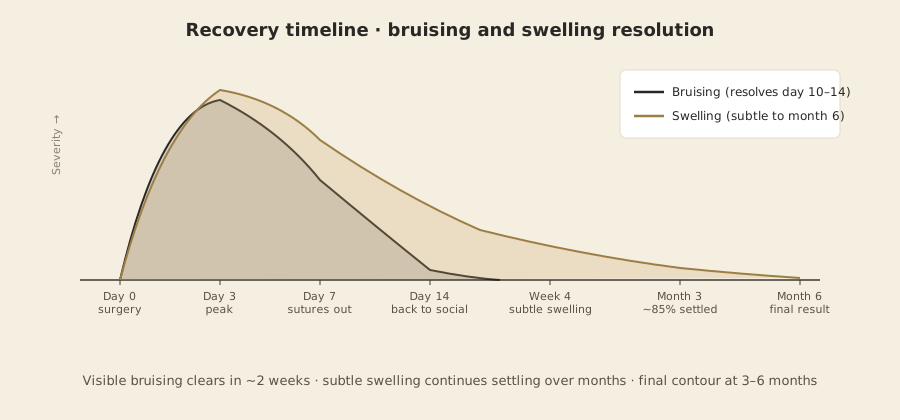
- Day 0–3: Maximum swelling and bruising. Cold compresses, sleep elevated, lubricating drops every 2 hours.
- Day 5–7: Sutures removed (upper lid). Bruising shifts from purple to yellow-green. Many patients can mask with sunglasses outdoors.
- Day 10–14: Major bruising resolved. Most patients return to social activities.
- Week 3–4: Subtle residual swelling only — visible to you in the mirror but not to others.
- Month 3: ~85% of the final result is visible. Scar is fading.
- Month 6: Final aesthetic result; scar mature.
Frequently asked questions
Can blepharoplasty be reversed?
No — removed skin and fat cannot be restored to native anatomy. Fat repositioning (the modern preferred technique) is partly reversible because the fat is still present, just relocated. Over-resection — particularly removing too much skin or fat — produces a 'hollowed' or 'surprised' look that revision can only partially address.
How long is the result expected to last?
The structural correction (skin and fat changes) is permanent. The natural aging process continues — most patients describe the eyes still looking better than baseline 10–15 years post-surgery, but not 'untouched.' A second procedure may be appropriate after 15–20 years for some patients.
Will there be visible scars?
Upper blepharoplasty: incision is in the natural upper lid crease, typically invisible within 6–8 weeks. Lower transconjunctival: incision is inside the lid — no external scar at all. Lower subciliary: incision is 2 mm below the lash line in the natural shadow, usually heals very well but is technically visible to close inspection at first.
Can blepharoplasty fix dark circles?
It depends on what's causing them. Shadow-from-bags: yes, surgery flattens the contour and removes the cast shadow. Pigmentation (genetic, vascular): no, that's a skin issue addressed by topicals, laser, or PRP. Tear-trough hollow: yes, fat repositioning can dramatically improve. Most patients have a combination; honest assessment identifies which components surgery can help.
Is the recovery painful?
Most patients describe blepharoplasty as 'remarkably not painful' — mild discomfort, tightness, and dryness, but not pain in the traditional sense. The dominant recovery challenge is bruising (which is unattractive but not painful) and the temporary inability to read or use screens comfortably for a few days.
Will I be able to close my eyes properly after surgery?
Temporarily, no — eyelid closure may be incomplete for 3–7 days due to swelling. This is normal and resolves spontaneously. We provide lubricating eye drops and a sleep-time ointment to protect the cornea during this window. Persistent lagophthalmos (inability to fully close) beyond 4 weeks is rare and usually indicates over-resection — a key reason for conservative technique.
Can I drive home from Istanbul after surgery?
If you live within driving distance of Istanbul: not on the day of surgery (sedation/anaesthesia residual effect). Most patients are cleared to drive from day 3–5. If you live more than 4 hours away, we recommend you stay overnight nearby.
Will my insurance cover blepharoplasty?
Cosmetic blepharoplasty: no — most insurance globally excludes purely aesthetic procedures. Functional blepharoplasty (where visual field obstruction is documented): in some countries (UK, Germany, US Medicare/private), yes — with documentation from ophthalmology including visual field tests. Even when insurance covers the functional component, any added cosmetic refinement is paid out-of-pocket.
Not sure if you're a candidate?
Blepharoplasty is most successful when patient anatomy, age, and goals align with what surgery can realistically deliver. Send three facial photos (front, profile, eyes-closed) and Doç. Dr. Erdal will give you an honest, no-pressure suitability assessment before you commit to anything.