
What it does
The lower lid has three fat compartments: medial, central, and lateral. When these herniate forward — pushing through a weakened orbital septum — they create the visible "bag." Transconjunctival blepharoplasty accesses these three compartments from inside the lid and either removes the excess fat or repositions it over the orbital rim to fill the tear-trough hollow.
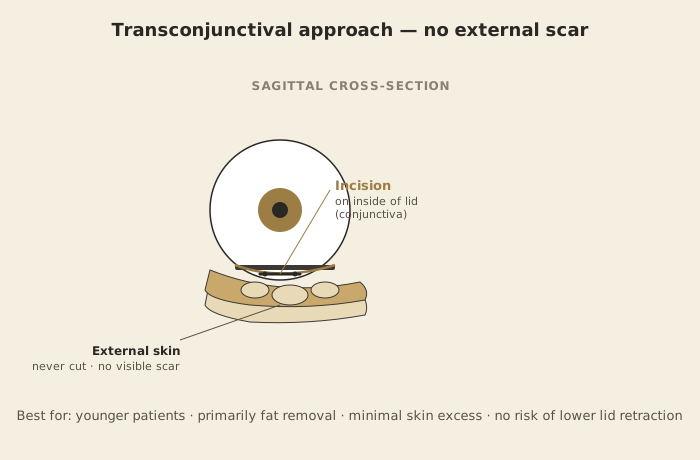
Key limitation: the transconjunctival approach cannot remove external skin. If skin needs removing, a skin-pinch can be added — but for cases with significant skin laxity, the subciliary approach is the right choice.
Who is best suited
The ideal transconjunctival candidate has:
- Visible fat bags as the primary complaint
- Elastic skin — younger patients, typically under 50
- Minimal lower lid wrinkles when relaxed (some wrinkling on smiling/squinting is acceptable)
- Hereditary pattern — bags that have always been there or appeared in their 20s/30s
- Negative vector concern — the safer approach when the eye protrudes past the cheekbone
Fat removal vs fat repositioning
The contemporary approach favours repositioning over removal wherever possible:
Removal excises the herniated fat, flattening the bag. Effective immediately but leaves no volume to age with — patients may look hollowed 10+ years later as the surrounding face loses volume.
Repositioning mobilizes the herniated fat as a flap and secures it over the orbital rim, where it fills the tear-trough hollow. The result addresses two concerns (bag + hollow) with the same tissue and ages better.
The choice depends on how much fat is herniated, the prominence of the tear-trough hollow, and the patient's age. A young patient with isolated bags and no hollow gets removal; a 50-year-old with bags above a deep tear-trough hollow gets repositioning.
Recovery profile
- Day 0: No external dressing. Cold compresses every 20 minutes.
- Day 1–3: Some lower lid swelling and chemosis (clear fluid swelling of conjunctiva). Vision is fine but eyes feel "puffy."
- Day 5–7: Most chemosis resolved. Bruising may be present but is in the lower lid only — not always visible without close looking.
- Day 10–14: Back to normal social activity. The internal incision has no sutures to remove (dissolving suture used).
- Month 3: Most swelling resolved; the contour is settling.
- Month 6: Final result.
Recovery is generally easier than upper bleph or subciliary lower — no external incision to manage, less bruising on average.
Real cases
Three lower blepharoplasty cases performed by Doç. Dr. Erdal, shown at 3, 5, and 6 months post-operative across multiple angles. Each case demonstrates the conservative fat-repositioning approach in different starting anatomies.
Frequently asked questions
Can I do transconjunctival if I also have some skin excess?
Yes, by adding a small 'skin pinch' — a thin ellipse of skin excised directly below the lash line under local anaesthesia. This combination addresses both fat and a small amount of skin without the full subciliary dissection. For more than a small amount of skin excess, subciliary is the right choice.
Will my eye shape change?
Not if done correctly. The transconjunctival approach is gentler on the lower lid support structures than subciliary, which is part of why it's preferred when feasible — the risk of lower lid retraction (lid pulling down, showing white below the iris) is essentially zero with this approach.
Why does the inside of my lid have an incision?
The conjunctiva (the pink lining of the lid) heals very fast — typically within 5–7 days — and leaves no visible mark. The incision is functional, not aesthetic, and is invisible once healed.
Can transconjunctival fix dark circles?
Partially — the shadow component of dark circles (created by the bag casting a shadow on the lower lid) improves dramatically. The pigmentation or vascular components do not change. Tear-trough repositioning can additionally fill the hollow that contributes to the dark appearance.
Not sure if you're a candidate?
Blepharoplasty is most successful when patient anatomy, age, and goals align with what surgery can realistically deliver. Send three facial photos (front, profile, eyes-closed) and Doç. Dr. Erdal will give you an honest, no-pressure suitability assessment before you commit to anything.
Ready to discuss your case?
Doç. Dr. Erdal personally reviews every enquiry. Honest assessment of whether blepharoplasty is right for you, with no pressure to book.